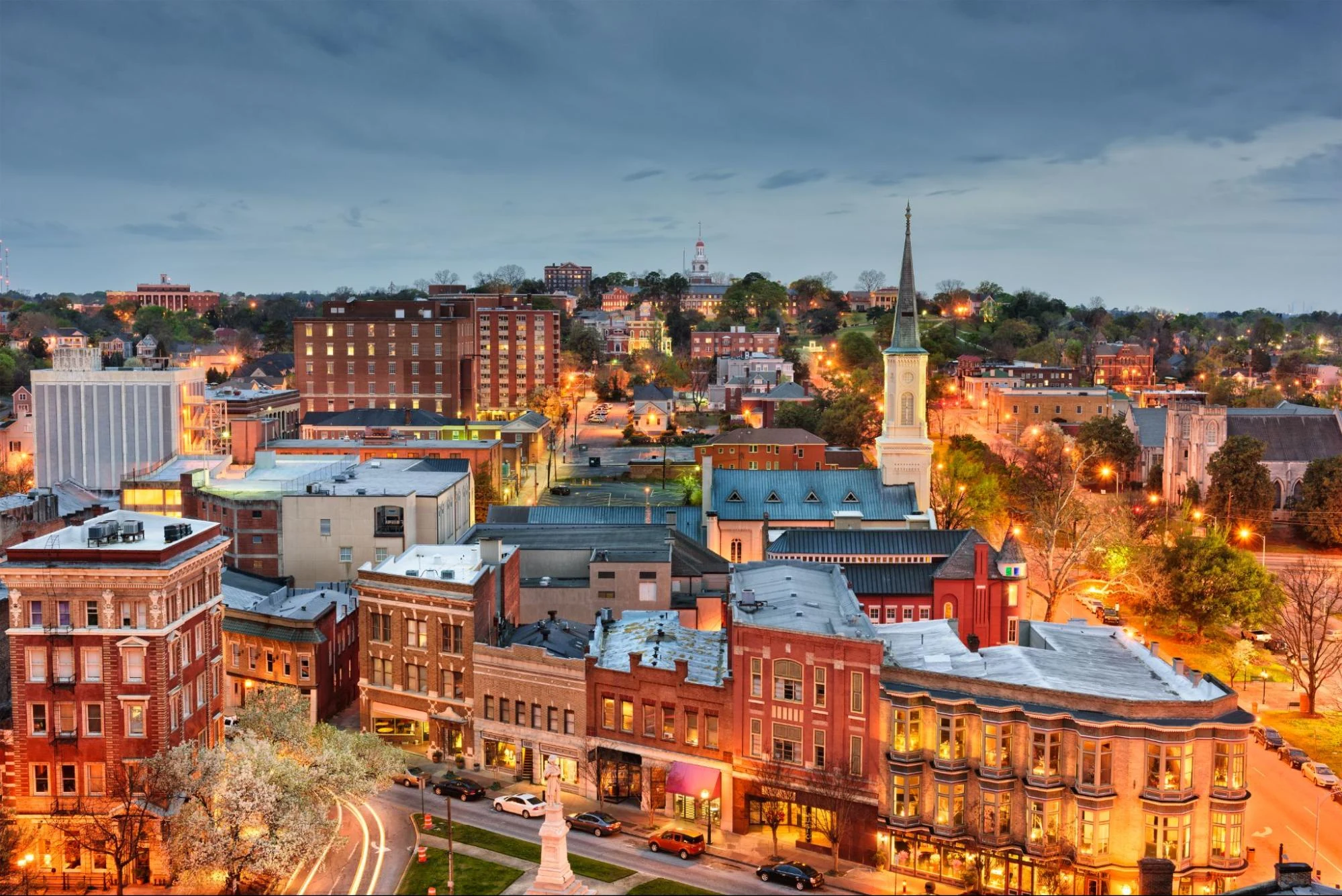
Commercial roofing in the Twiggs County Seat, GA should begin with a documented assessment of membrane condition, seams, flashings, drainage, penetrations, and moisture before repair, coating, or replacement is selected. Jeffersonville is Twiggs County's seat, a courthouse-square town where the county government's buildings, a scattering of timber and sawmill operations, and easy access to I-16 make up most of the commercial roofing work. It's one of the smallest county seats we serve out of Macon, and the roofing base reflects a rural county's actual footprint rather than anything resembling a metro submarket. It's a small base, and we scope it accordingly rather than pretending a town this size supports a large retrofit market.
Public roofing work in Jeffersonville runs through the county's own procurement process, which typically means a formal bid, a defined specification, and a prevailing-wage determination we confirm before pricing the job. County facilities staff usually have a good sense of their own building's maintenance history, and we start by reviewing whatever records they can produce rather than assuming we're working from a blank slate. In a county this size, one facilities employee often manages every county-owned building, which means that institutional knowledge is worth more than a formal maintenance log that may not exist.
Courthouse and administrative buildings in a town this size are often older structures that have been reroofed once or twice already, and matching a new system to an existing parapet height, expansion joint, or HVAC curb layout takes more field verification than a brand-new building would need.
Twiggs County's timber economy supports sawmill and log-handling operations with their own roofing profile, open-sided equipment shelters, dry kilns, and enclosed processing buildings that combine high interior heat with sawdust exposure. Dust buildup on a roof surface behaves like any fine particulate, holding moisture at seams and around penetrations longer than a clean roof would, and kiln buildings add a heat-load consideration that a standard commercial spec doesn't address. Sawdust in particular finds its way into places you wouldn't expect on a roof, packed against curb bases and into gutter runs, and it holds water there the way any organic debris would if it isn't cleared out on a regular schedule.
We scope timber-facility roofs around how the building is actually used, checking penetrations for kiln venting and dust-collection equipment specifically rather than applying a generic warehouse inspection checklist.
Jeffersonville's position a short drive from I-16 has brought in a modest amount of trucking and light-distribution activity over the years, mostly smaller operators drawn by land cost rather than the larger logistics parks closer to Macon or Dublin. That growth is real but limited, a handful of metal buildings and truck-service structures rather than a distribution corridor, and we price and staff jobs here with that scale in mind. We don't pitch a Jeffersonville client on a service tier built for a large logistics park, since the actual maintenance need for a building this size rarely justifies it.
The blocks around the courthouse hold a small set of older commercial buildings, offices, a bank branch or two, and a few service businesses, most with steep-slope or older built-up roofs that have been patched more than once. Repair work here is about extending the life of an existing structure economically, not selling a full system replacement to a small-town building that doesn't need one.
Summer heat in this part of the state pushes surface temperatures on dark roof membranes well past ambient air temperature, which accelerates aging on any roof already past its expected service life, common on the older courthouse-square buildings. Fast-building afternoon thunderstorms are routine through the summer months, and a roof with clogged or undersized drainage, common on buildings that have added equipment over the decades, shows ponding problems within a single hard rain.
We check actual drainage capacity against current roof conditions during every inspection rather than relying on what the original design assumed decades ago. A gutter or scupper sized for a smaller original footprint often can't keep up once a building has added a rooftop unit or a small addition, and that mismatch is easy to miss without walking the roof directly after a storm.
Yes, including projects with prevailing-wage requirements, which we confirm and price to before submitting a bid.
Yes, we scope those roofs around the building's actual use, including dust exposure and kiln-related heat, rather than a generic warehouse checklist.
It's a small town's worth of buildings, and we plan visits around actual maintenance need rather than a fixed route through a larger market.
Yes, that field verification, matching parapet height and existing penetration layouts, is routine work for us on courthouse-era structures.
Yes, we provide emergency tarp and dry-in service to protect equipment and stock while a permanent repair is scoped and scheduled.