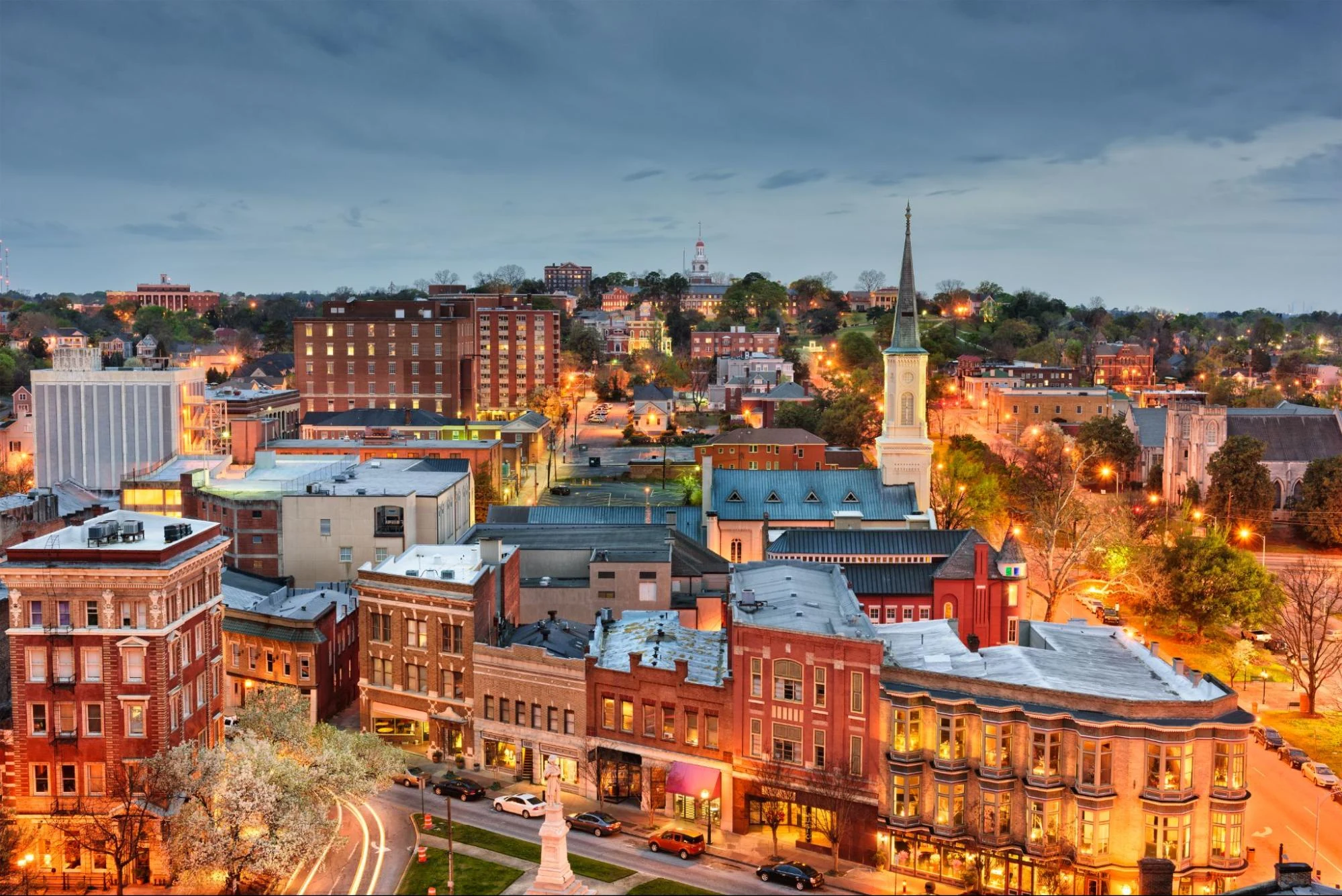
For commercial properties in Barnesville, GA, the defensible choice between repair, restoration, and replacement starts with roof-system condition, moisture findings, drainage performance, and remaining service life. Barnesville is the Lamar County seat, a former buggy and textile-mill town with a historic downtown and a Gordon State College campus that between them carry most of the commercial roof stock in the area. We bid roofs across both categories, and they call for different specs.
Downtown Barnesville is a compact grid of brick storefronts, several dating back to the town's mill-era prosperity, now housing a mix of small retail, offices, and antique dealers who've taken over some of the older commercial space. Those buildings mostly carry low-slope roofs behind decorative parapets, often invisible from the street, which means condition problems can run for years before anyone notices from ground level.
Gordon State College, a couple of miles from downtown, is a different scale entirely: academic buildings, a library, athletic and support facilities, all under some form of institutional roof management. Campus work runs on academic-calendar scheduling and procurement processes closer to what a county government or hospital system would require, which is where our bid-package experience carries over directly.
Parapet-hidden low-slope roofs on Barnesville's historic storefronts are frequently modified bitumen or older built-up systems, sometimes patched multiple times by different contractors over the decades. We start every downtown proposal with a full deck assessment rather than assuming the roof underneath a recent-looking coating is sound, since coatings on these buildings often mask deeper substrate problems.
Because many of these storefronts share party walls, water intrusion at one roof edge can affect the building next door. We flag shared-wall drainage issues in our proposals even when they fall outside the immediate scope, so an owner isn't surprised by a neighbor's roof problem showing up on their side.
A number of downtown spaces have changed hands from retail to antique and specialty use in recent years, and that shift often means new tenants inheriting roof problems nobody disclosed at closing. We recommend a pre-purchase inspection to any prospective downtown buyer who asks, since a roof assessment done before closing is far cheaper than one done after a ceiling has already stained.
College and institutional roof work runs on a different timeline than a downtown storefront job: academic-year scheduling that avoids move-in and exam periods, formal submittals with product data sheets, and warranty documentation that satisfies an institutional facilities office. We build those packages the same way for a campus building as we would for a hospital or county government roof.
Multiple buildings on a campus of Gordon State's size are rarely all the same age or system, which means a single roofing contract can involve a mix of specifications: TPO on a newer academic wing, older built-up membrane on a support building, standing seam on anything with a more traditional roofline. We price each section on its own merits rather than forcing one system across the whole campus.
Lamar County sees the same summer thunderstorm pattern as the rest of Middle Georgia, with UV exposure and heat-cycling that ages an older membrane faster than it would a newer one. On Barnesville's mill-era buildings, decades of thermal expansion and contraction have often opened seams that a fresh membrane wouldn't show yet, and we look for that history specifically rather than treating every leak as new damage.
Freeze events are infrequent but not absent in Middle Georgia winters, and a hard freeze after a wet stretch can be the final failure point on a membrane that's already brittle from age. We note that pattern in inspection reports on older downtown roofs so an owner understands why a seemingly minor leak showed up when it did.
A campus facilities department manages roofs alongside HVAC, grounds, and building maintenance, usually with more formal documentation requirements than a downtown property owner would ask for. We provide the submittal packages and warranty paperwork that kind of office needs to close out a project cleanly, following the same process we use on other institutional work described on our higher-education roofing page.
Yes, and we schedule that work around the academic calendar with full submittal documentation for the college's facilities office.
We assess the deck directly rather than relying on the visible coating, since parapet walls hide these roofs from street-level inspection.
Yes, and we flag that risk in our proposals so an owner understands the shared-drainage exposure before work begins.
Modified bitumen recover or standing seam metal repair are the most common paths, chosen based on what the existing structure can support.
Yes, and a scheduled program is usually the better long-term value for a facilities department managing several roofs at once; details are on our preventive maintenance page.